Saturday, June 27, 2015

Summer Book List: Learning about the National Basketball League

Recently I had time for a little pleasure reading, so I picked up Murry Nelson's history of the National Basketball League. For those not familiar, the NBL was one of two leagues (the Basketball Association of America was the other) to merge in 1949 and form the National Basketball Association.

The impetus for the book came back in 1996 when the NBA celebrated its 50th Year Anniversary. Nelson, a leading historian of basketball, cried foul, noting that 1996 was 50 years after the BAA's founding, not the NBA's. As for the NBL -- the other half of the merger that created the NBA -- it had been around since 1937. Choosing 1946 as the beginning of the NBA blatantly ignored both the importance of the NBL and the historical record.

Not surprisingly, Nelson's pleas went unheard. The NBA went ahead with its celebration in 1996 and continues to mark 1946 as the starting point in league history. In light of this, an angry and inspired Nelson set out to recover the NBL's history. In The National Basketball League: A History, 1935-1949 (McFarland, 2009) he's done just that, providing the definitive account of the league that from 1937 until 1948 was "the undisputed premiere professional basketball league in the United States."

Nelson certainly has a point when arguing for the superiority of the NBL. He estimates in the book that 90 percent of the best professional basketball players in 1947 played in the NBL. It's impossible to know with certainty whether or not that estimate is correct, but we do know that the first six NBA champions were NBL teams, and that in the NBA's first season six of the ten All-NBA players were from the NBL while only one came from the BAA (three rookies also earned All-NBA honors). Of course, in the 1940s some of the nation's top basketball players, including Hank Luisetti, Bob Kurland, and Jesse Renick, found homes and stable employment on company-sponsored AAU teams. And, an even greater asterisk, professional basketball leagues mostly barred blacks from playing (more on that in a second), leaving the top African American players to join famed traveling teams like the Harlem Globetrotters and the New York Rens.

Thursday, March 19, 2015

Writing about Nebraska

One of my favorite stops on the internet is Religion & Politics. They're not a rapid-fire content accumulator or aggregator. Instead they post just one article a week. But that one article is almost always something worth reading.  

To someone like me, someone who is intensely interested in notions of place and identity and how those relate to religion, perhaps the coolest thing R&P has going on is their "States Project." Here's how they describe it: 
We gathered writers from around the country to tell us about where they discovered religion and politics in their states. Both part of a union and cultures unto their own, these states reveal stories of people, places and histories of the American experience. 
As of last week, they had covered 23 states. This week, they added their 24th state: Nebraska. And I was fortunate to be the writer they allowed to take on the Cornhusker state. If you haven't yet, you can check out my piece, "Nebraska: A Cornhusker Prays with FCA." I wrote about one way that sports, religion, and the power of place are linked together in Nebraska.


After you read that piece, feel free to catch up on my other Nebraska-related writing from the past couple of years. Among other things, I've written about the fantastic Omaha-based 1960s documentary film, A Time for Burning, the NBA's brief 1970s foray into Nebraska, the religious beliefs of legendary Nebraska Senator George Norris, and brand-new Nebraska Senator Ben Sasse's relationship to the Christian Right. I've also published an article in Nebraska History on Charles W. Savidge, a pioneering turn-of-the-twentieth-century holiness movement pastor in Omaha. And finally, one last plug: in August, I'll be publishing a second piece with Nebraska History. More details to come on that in the near future.

Tuesday, December 30, 2014

Year in Review: My Favorite Music in 2014

It's time for my annual year-end list of favorite albums. I'm no music critic, so my criteria for which albums make the cut follows the Lemon test: I know what I like when I hear it. Normally I'd write a little blurb for each of these twelve albums, explaining why it's a favorite. Unfortunately, I'll have to set aside that little extra flourish this year due to time constraints.

With that said, onto the list!

Favorite Song: Patriarch
Favorite Song: The Dark (Trinity)


Thursday, October 2, 2014

Historians and Social Media: A Grad Student's Perspective

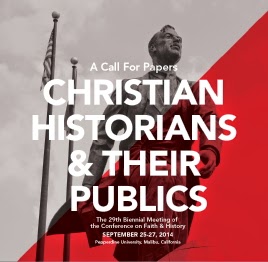
Last weekend I traveled to sunny Malibu for the 2014 Conference on Faith and History. As you can see from the image on the left, the conference theme was centered around the notion of the historian's "public." As a graduate student, my perspective on who my public is and how I want to reach them is necessarily different from established historians. Thanks to my participation in a roundtable focusing on "Christian Historians and Social Media," I was able to discuss some of those differences.

The mastermind behind the roundtable, Jonathan Den Hartog, orchestrated a plan to have each of the participants post his comments from our roundtable online this week. You can read Den Hartog's introductory remarks at his blog, John Fea's comments at his blog, and Chris Gehrz's reflections at (yes) his blog. Or one of his four blogs, I should say.

To round out our series of posts, here are my comments. They have not been edited for clarity or length. You get 'em in all their original muddled glory.
                                                                                                                                                          

Friday, August 15, 2014

Favorite Writing Music in 2014

We're now into the second half of 2014, and as usual I've been keeping track of my favorite new albums. I'm never able to keep up with everything that comes out, but from what I have listened to thus far my top 12 albums list would probably include (in some order): The War on Drugs, Conor Oberst, Lykke Li, Old 97s, Cloud Nothings, Sun Kil Moon, Run River North, How to Dress Well, The Roots, Common, Spoon, and Atmosphere. 

Usually I approach a new album by listening to it all the way through a few times, then selecting the songs that I like from the album and adding them to a "Best Songs of [Year X]" playlist on Spotify. Those songs then get played extensively whenever I take up a writing project. Below, I've compiled my ten favorite writing songs from albums released in 2014. This isn't necessarily a "ten best songs" list. Rather, it's a list of the songs that have provided the best writing soundtrack. As you can see from the list, I tend to gravitate towards songs that are wistful, pensive, or earnest in tone. Suggestions/snide comments welcome.

(Since some albums had multiple songs that would have made the list, I decided to limit each album to only one song. Click on song title to check out the songs for yourself.)


Tuesday, August 5, 2014

Finally, a Langball Explainer

What is langball? (also known as "Lang ball" and "hang base ball")
Langball is a now-defunct game invented by C.G. Lang, a YMCA director in St. Joseph, Missouri, sometime around 1892. It's something like baseball or kickball, except that the batter in langball dangles from a horizontal bar or flying rings, striking the pitched ball with the bottom of their feet. Kind of like this:

Pic from Los Angeles Herald, April 19, 1896.

What happens after the ball is kicked?
The batter then runs to first base, much like in baseball, with the goal of eventually making it back to home base and scoring a run. Depending on the rules being used, there could be as few as two bases or as many as four.

Any fly ball caught by the defense is an out. But the rules for getting a runner out vary: if a light rubber ball is used, then the defense must hit the runner with the ball to get them out. Sometimes, however, a medicine ball is used. This brings an element of danger, for (as one early promoter of the game explained), "this indiscriminate throwing will endanger windows and apparatus, if not heads." Thus, the medicine ball version usually outlawed throwing at runners to get them out. Instead, you threw to the base, as in baseball.

Pic from Physical Education 1.2 (April 1892): 32.

Thursday, July 24, 2014

For Christians, Must Art Always Serve A Purpose?

Over at Christ and Pop Culture, Jordan Monson wrote a short piece titled "Do Christians Have Poor Cultural Taste?"

Monson began the piece by describing a "beautiful and melancholy" film that he viewed with a couple Christian friends. Monson loved the film: "In a mere three hours it led me through the full spectrum of human emotion," he wrote. "I empathized—even lamented—for its fictional characters. But my sorrow was of the redemptive kind, and it convicted me to go forward and share the hope of Christ with those who search in vain."

But his friends were not so enthused. One didn't like its lack of transforming robots; another thought that it did not teach viewers the proper moral behaviors.

From there, Monson began to wonder why it was that his friends and many other (evangelical) Christians were unable to appreciate the movie like he was. He assigned three factors to this tendency: having poor taste, "misunderstanding the role secular art can play in our lives," and something about fast-food culture vs. art.

Monson brought in the big gun for his analysis: C.S. Lewis. Lewis, according to Monson, argued that to have good taste one must receive art ("temporarily suspend judgment")  instead of use art (where art is simply a means to advance one's agenda). Monson agreed, arguing that evangelicals must learn to receive art (in a discerning way, of course), even from "secular" sources. And he suggested that approaching art in this manner "should inspire us to grow into better Christians, parents, evangelists, laborers, and listeners."

Like Monson, I too have wondered why it is that evangelical Christians have a tendency to enjoy terrible movies, music, and books. But it's not just the enjoying part -- the movies, music, and books that are most popular among the broad American population I often find terrible, too. What makes many evangelicals different is the fact that they often really, really want others to enjoy the cultural good as well (this is why they do things like rent out theaters for Son of God). Many believe that by getting others to partake of the cultural good, others will be sanctified or made better in some way. And on the other side of the coin, many evangelicals believe that some movies/music/books (often deemed "secular") will make people spiritually worse in some way. Why is this?

Thursday, June 26, 2014

College Majors and College Degrees for the 2014 NBA Draft Prospects

To complete my various posts related to the NBA and college degrees this week (see here, here, and here), it's time to take a look at the 2014 crop of NBA prospects

It should come as no surprise that most of the top talents in the draft don't have a college degree. The reason is simple: it makes little sense to stay in school for four years while the NCAA, your conference, and your school all make money from your basketball ability. If you are talented enough to be a first round pick in the NBA and get a guaranteed three-year contract worth millions, you should probably get out of the NCAA ASAP. If a college degree is important, there is always time to go back after (and even during) your NBA career.

Fitting in with recent precedent, this year only four of Draft Express's top 35 prospects can claim to have a college degree. But if the likely first-round picks are set aside, the number of college degrees ticks up quite a bit. Over half (thirty-eight in all) of Draft Express's prospects ranked from 36-100 have college degrees. And many of those prospects who do not have a degree are international players who did not attend an American college. In short, college players who are not locks to be a first-round pick often stick around for four years, get their degree, and then hope for a shot with an NBA when it's all done.

Of course, the transition from college to the NBA was not always set up this way. Originally, the NBA's rule was that rookies could not play in the NBA until their college class graduated. For example, when Wilt Chamberlain decided in 1958 to forego his senior year at Kansas, he had to wait a year -- even though he was drafted by Philadelphia through the NBA's territorial rule -- before he could enter the league.

Since players had to wait four years after high school graduation anyway, most stayed in college and got their degree before they entered the league. Those who did not generally had only a couple courses left to complete for the degree. This was the situation for Chamberlain's rival big man, Bill Russell. Russell planned to finish his classes at San Francisco during the summer after his first NBA season. However, when San Francisco made it clear that Russell would have to pay for the courses himself, he left the school, never to return (and never to receive his degree).

So what caused the NBA to change its policy?

Wednesday, June 25, 2014

The Most Interesting College Degrees in the NBA

Over the past two days I've used a not-biased-at-all research process to determine which college degree has produced the best NBA players. (Here are the links to Part 1 and Part 2). But since I only included the college degrees that had at least six NBA players, there were some interesting degrees left out of my analysis. Below, I've included a few of them.

1) Emeka Okafor (Finance), Jeff Hornacek (Accounting), and David Robinson (Mathematics)

The number crunchers. Before you get to the jokes about how boring accountants are, here's a video of Jeff Hornacek subverting accounting stereotypes.


2) Kyle Korver (Visual Studies), Kyle Singler (Visual Arts), Patrick Ewing (Fine Arts, poster/print design)

In contrast to our first group, these three are on the opposite side of the right brain/left brain false dichotomy. Kyle Singler's art projects used to get attention back when he was winning national titles with Duke. But no one has put their studies to better use than Patrick Ewing.