Sunday, February 19, 2017

Amos Alonzo Stagg and Japanese American Internment

Last year I received a Platzman Fellowship from the University of Chicago Library, which allowed me to spend some time over the summer in the Amos Alonzo Stagg Papers. Stagg was a leading figure in the "muscular Christianity" movement of the late nineteenth and early twentieth centuries. He first earned fame as a baseball pitcher and football end while playing for Yale in the 1880s. Thanks to his celebrity, Stagg attracted eager audiences in the Northeast as he lectured on the importance of faith and the blending of Christianity and athletics.

After his college days Stagg embarked on a coaching career, most notably with the University of Chicago. He coached the Chicago Maroons for forty years from 1892 until 1932, all while continuing to espouse the Christian values that he claimed could be imparted through the game of football. Because Stagg will be a crucial figure in my dissertation (which explores how particular forms of Christianity were embedded within the world of big-time sports in the United States), it was incredibly helpful to spend time with his papers in Chicago. 

During my research, I came across a few really fascinating sources. Most of them will make their way into my dissertation one way or another. But I could not resist the desire to make at least one set of sources public before the dissertation is complete. That set of sources -- including letters, telegrams, and newspapers clippings -- details Stagg's role in defending the rights of Japanese Americans in early 1945, near the end of World War II.

As far as I know, no other scholar has written about Stagg's campaign on behalf of interned Japanese Americans. But the good folks at the Sport in American History blog allowed me to share what I had learned about Stagg. After that story was published, one of my favorite radio shows, Only A Game, asked me to talk about my story with them as well. They produced a great 12 minute segment about Stagg that was featured on their February 17 show. 

If you haven't had a chance to read or listen yet, feel free to check them out:


Wednesday, November 16, 2016

On the Omahawks, Omaha's First Big-League Basketball Team

In the next issue of Nebraska History I have an article that details the brief history of the Omahawks, a professional basketball team that existed for a few weeks in 1947. Although mostly forgotten by Omaha residents today, it was Omaha's first major professional sports franchise.

I sent an advance copy of the piece to one of my favorite sports writers, Dirk Chatelain of the Omaha World-Herald. After he expressed interest in the topic, I wrote a short summary piece about the Omahawks that Chatelain published at his Mad Chatter blog last week. You can check out the blog here.  After the piece ran, I was contacted by The Bottom Line, a sports and news talk show hosted by Mike'l Severe for the Omaha World-Herald. Back when I lived in Omaha, Severe and Kevin Kugler co-hosted a radio show called Unsportsmanlike Conduct. I have yet to find a sports talk show that I enjoy more than Unsportsmanlike Conduct (in fact, I've pretty much given up on trying). So it was a thrill to talk about the Omahawks with Severe.

If you'd like to check out my interview on The Bottom Line, you can go here. Below, you can also read my short piece on the Omahawks that originally ran at the Mad Chatter blog. And for even more on the Omahawks, check out the next issue of Nebraska History.

Omaha World-Herald, Nov. 12, 1947

Monday, February 1, 2016

African Americans and Omaha: A Reading List

Recently I reviewed Tekla Agbala Ali Johnson's Free Radical: Ernest Chambers, Black Power, and the Politics of Race (Texas Tech University Press, 2012), for an academic journal. Although I made a few critiques, I think that Johnson's biography of Chambers is incredibly important. Because Chambers has toiled in Nebraska his entire life, serving since 1970 (with one brief hiatus) as the legislative representative for Nebraska eleventh district, he has not received as much attention on the national level as his talent, charisma, and penchant for controversy deserves. Love him or hate him, Chambers is one of the most fascinating political leaders in Nebraska history. Johnson's biography should be read by anyone interested in the history of the U.S. black freedom struggle or in Midwest, Nebraska, or Omaha history (for more on Chambers, I've written briefly on him elsewhere, focusing on his starring role in the acclaimed documentary A Time for Burning).

In national histories of the long civil rights movement, Omaha often gets mentioned for two things: it was the birthplace of Malcolm X, whose parents served as leaders of Marcus Garvey's Universal Negro Improvement Association in the city during the 1920s, and it was the scene of the horrific riots and mob murder in 1919 of Will Brown, whose assailants posed smiling for the camera as his body burned.

But thanks to Johnson's biography of Chambers, and also to a recent influx of books documenting Omaha's rich history of African American leadership and civil rights protest, readers can now get a much better sense of the struggle and vitality of African American life in Omaha. I've listed three recently-published books that would make great companions to Free Radical below. All of these books tend towards an emphasis on the heroic. That is, while they do not ignore the segregation, mob violence, and police brutality inflicted upon Omaha's African American residents over the past century, they tend to highlight more the resilience of those fighting for justice. I can only hope that over the next few years we'll see even more work of this quality on the history of African American life in Omaha.

Monday, November 16, 2015

The Rest of Tom Osborne's "Currens Story"

Legendary former Nebraska football coach Tom Osborne has long promoted the importance of mentoring. In 1991 he and his wife Nancy launched the TeamMates Mentoring Program, aiming to inspire youth to reach their potential by matching them up with an adult mentor.

Part of Osborne's motivation is personal. As he has often explained, his grandfather, Thomas C. Osborne, grew up on a farm in western Nebraska in the late 1880s/1890s. Thomas's home life was somewhat dysfunctional because his father was an alcoholic. But a traveling preacher named Currens took an interest in Thomas. Currens encouraged him to go to college -- something that was exceedingly rare in the nineteenth century -- and to become a preacher. Thomas did just that, enrolling at Hastings College, captaining the football team, and eventually earning his Presbyterian ordination. "I'm quite certain that if it wasn't for this guy named Currens who was a mentor to my grandfather," Tom Osborne explains, "that my father wouldn't have had the life he had, [and] I would not have had the life I've had."


But who was this "Currens" character in the first place? I have not seen Osborne or anyone else provide many details beyond his last name and occupation. So I decided to see if I could piece together some details about the man who, by Osborne's account at least, unknowingly altered the history of Nebraska football more than a century ago.

From History of Western Nebraska
and its People
(1921)
I suppose we can start with his name: James B. Currens. Currens was born in Kentucky around 1842. A nineteen-year-old living in a border state when the Civil War broke out, it is unclear if Currens fought for the North or South (or at all) during that conflict. But we do know that he married a woman from Kentucky named Susan, and that he settled in Mattoon, Illinois, sometime after the war. We also know that in 1877 he moved to Chicago to enroll in the Presbyterian Theological Seminary of the Northwest (renamed McCormick Theological Seminary in the 1880s). After receiving his D.D. from the school in 1879, Currens headed west for the plains, leaving Susan behind with friends in Illinois while he tried to establish himself in the new town of Parker (population: 113), in southeast Dakota Territory.

Currens spent his first summer in Parker building an eighteen-by-twenty-foot house, made of boards and paper. He also tried to establish connections with "widely-scattered Christians" in the area, but the work was hard and discouraging. "Covetousness, Sabbath-breaking, and intemperance are here before us, and meet us on every hand, undisguised, bold, and defiant," he wrote. The settlers were so busy building their homes and tending to their farms that Currens found it nearly impossible to "induce them to stop and think of religion." But Currens soldiered on, laboring in sparsely populated McCook and Turner counties for the next six years. One settler from the time recalled that Currens pastored seven churches and routinely preached in three different towns every Sunday. By 1883 Currens was reuinited with Susan, and the two earned reputations as local champions of the temperance cause.

Monday, August 10, 2015

Flannery O'Connor's Favorite Protestant Theologian

I did a double take when I saw this passage:

"She never missed Dr. Frank Crane, an advice columnist....Appearing on the same page as the comics in the Atlanta Constitution, he was a prophet of positive thinking, regularly reporting success stories of people who smile and compliment others. O'connor jokingly called him her 'favorite Protestant theologian.'"

The passage comes from Jonathan Rogers's 2012 book, The Terrible Speed of Mercy: A Spiritual Biography of Flannery O'Connor (Thomas Nelson). It probably didn't startle others the same way it startled me. But as a wannabe historian, this passage had the potential to make my research relevant. Here was Flannery O'Connor, a darling of the thoughtful Christian crowd, apparently an avid reader of Frank Crane, the subject of my new Nebraska History article. 

Almost everything seemed to fit. Frank Crane was indeed an apostle of positive thinking and also a syndicated newspaper columnist. Norman Thomas, writing in The Nation in 1924, aptly described Crane's style as something "a Pollyanna might have written after a short course in William James's pragmatism and a shorter and somewhat critical course in Tolstoi's non-violent ethics."

Frank Crane in American Magazine (1922)
There was just one problem: Crane died in 1928. And O'connor was reading "Dr. Frank Crane" in the 1950s. It was at least possible that Frank Crane's columns were being reprinted decades after his death, but it seemed unlikely. So I decided to investigate. I went to the sources cited by Rogers, all of which came from The Habit of Being, an edited collection of O'connor's letters. As the letters showed, O'connor definitely peppered her letters with references to Crane. "Ashley was telling me that you are an admirer of Dr. Frank Crane, my favorite Protestant theologian (salvation by the compliment club)," she wrote to Robie Macauley in 1955. "He is really a combination minister and masseur, don't you think? I like to hear him tell Alma A. that she can keep her husband by losing 75 pounds and just the other day he told a girl who was terrified of toads how not to let this ruin her life -- know the truth & the truth shall make you free."

In another letter to Macauley, she cracked more jokes about Crane: "I'll write Dr. Crane and ask him what is the significance of the short story. He tackles any subject." Elsewhere, she described Crane as an "odd mixture of fundamentalism (against the grape), psychology, business administration and Dale Carnegie. The originator of the Compliment Club."

Monday, August 3, 2015

Summer Book List: The Rise of the National Basketball Association

If you're looking for a book on the history of the NBA that features tables with titles like "Fixed-Effects Regression Equation for NBA Gate Receipts, 1950– 51," then this is your book and David George Surdam (a professor of economics at the University of Northern Iowa) is your author.

To be fair, Surdam's tables, all thirty-three of them, are placed in Appendix B. The main text of the book follows the typical chronological pattern of most descriptive histories. Within that text, though, Surdam offers a unique angle to the NBA's early history that (like the charts on fixed-effects regression equations) could only come from an economics professor. Forget Bill Russell, the owners are the heroes in The Rise of the National Basketball Association. Men like Walter Brown, Fred Zollner, Les Harrison, Eddie Gottlieb, Ned Irish, Ben Kerner, and Maurice Podoloff, should "justly feel proud of their efforts," Surdam writes, because they held the NBA together with "determination" and "a willingness to absorb losses."

To get at the owners' perspective and to explain the choices they made -- from integration, to television contracts, to gate receipt sharing, to league rules, to expansion and franchise relocation -- Surdam relies on a mix of secondary literature, New York Times and other national print media, archival research at the Naismith Hall of Fame, and a 1957 Congressional antitrust hearing on "Organized Professional Team Sports." Numerous NBA owners testified at that hearing, providing documentation on league finances and operating procedures that help Surdam analyze the economic underbelly of the league in a new way.

Thursday, July 16, 2015

Frank Crane, From the Pulpit to the Press

A couple years ago on a Tuesday afternoon I drove to First United Methodist Church in Omaha, Nebraska. There I met Diane and Donna, the church's two archivists. They work on a volunteer basis, coming in once a week to organize and preserve pieces of the church's past.

When I arrived Diane and Donna led me down concrete stairs to the church basement, into a small storage room that served as the church's archive. They knew that I was interested in 1890s Omaha, and they mentioned that they had the perfect source for me: a weekly church newsletter that was distributed for most of the 1890s. After scanning the archive shelves, Donna pulled down two dusty old volumes titled "The Guidon."

I did not expect to find much excitement in a weekly church newsletter. Event announcements, membership lists, sermon summaries: in and of themselves these items did not pique my interest. But I knew that studying the routine activities of Omaha's leading 1890s Protestant church would be valuable. I was also interested in finding themes related to the social gospel. As I flipped through the two bound volumes and took pictures of the pages, I looked for signal words like "Washington Gladden" and "fatherhood of God."

To my surprise The Guidon's contents frequently exhibited a flair for the creative (or at least the unexpected). Instead of mindlessly snapping pictures for future use, I found myself pausing and reading, constantly drawn into the personality exhibited in the text. To take but one example: in order to convince church members to accept a new system of church finances, the editor wrote a parody of the wildly popular 1894 free-silver tract Coin's Financial School. In the original, a man named Professor Coin taught bankers and businessmen the benefits of bimetallism. In the parody, a man named Gould Coin taught First Methodist board members the benefits of a monthly subscription-based church giving system.

Intrigued, I resolved to find out more about Frank Crane, the editor of The Guidon and the pastor of First Methodist from 1892 until 1896. I began my search, as most do these days, with google. And very quickly, thanks to the plethora of digitized newspaper and magazines from the pre-1922 years, I discovered that the Frank Crane who edited The Guidon in such an interesting way was the same "Dr. Frank Crane" who became perhaps the most widely read syndicated newspaper columnist in the early twentieth century and an icon of middlebrow American consumer culture.

From LIFE magazine in 1920.

Thursday, July 2, 2015

Summer Book List: Henry George (and George Norris) and the Crisis of Inequality

Note: this is the second book in my "Summer Book List" series. In the first installment I discussed Murry Nelson's The National Basketball League: A History.

May 2, 1930 was an active day in the U.S. Senate. With unemployment already well past three million people, the economic downturn that would become known as the Great Depression occupied the minds of many senators.

On that particular day, though, the main issue at hand was the confirmation of President Hoover's nomination for the Supreme Court, John J. Parker. A longtime resident of North Carolina, Parker's nomination was part of Hoover's plan to attract southern Democrats into the Republican fold. But the nomination of Parker, a lily-white Republican with a history of racist statements and actions, sparked opposition from the NAACP. Labor leaders were not happy with Parker, either, criticizing his use of injunctions against strikes and his support for yellow dog contracts.

What authority could be invoked in these debates and discussions over a growing economic crisis and a controversial Supreme Court justice? For Senators Gerald Nye and George Norris, that authority came in the voice of a nineteenth-century reformer named Henry George. Early in the day's proceedings, Nye inserted into the Congressional Record George's late-nineteenth-century words on inequality, condensed into more palpable form by George's son-in-law Will Atkinson:


Later in the day, during a two-hour speech explaining why he opposed Parker's nomination, Senator Norris turned to George as well, quoting "one of the most beautiful things I have ever read on the preciousness of human liberty." The lengthy quotation from George's Progress and Poverty spanned three paragraphs, ending with George's plea: "In our time, as in times before, creep on the insidious forces that, producing inequality, destroy liberty....Unless its foundations be laid in justice, the social structure cannot stand." For Norris, Judge Parker's history of judicial activism against labor meant that he would only exacerbate the problem of economic equality made conspicuous in the wake of the 1929 Crash. Ultimately, Norris's view (alongside the NAACP and others), won the day. Parker's nomination failed by one vote.

It should be no surprise that Henry George -- one of the earliest and most prominent voices pointing out the danger of inequality in Gilded Age America -- was invoked in 1930, a moment when the problem of economic inequality seemed obvious. So, too, it is only fitting that in 2015, a time when the problem of economic inequality once again holds the nation's attention, we should have a new biography of Henry George.

Saturday, June 27, 2015

Summer Book List: Learning about the National Basketball League

Recently I had time for a little pleasure reading, so I picked up Murry Nelson's history of the National Basketball League. For those not familiar, the NBL was one of two leagues (the Basketball Association of America was the other) to merge in 1949 and form the National Basketball Association.

The impetus for the book came back in 1996 when the NBA celebrated its 50th Year Anniversary. Nelson, a leading historian of basketball, cried foul, noting that 1996 was 50 years after the BAA's founding, not the NBA's. As for the NBL -- the other half of the merger that created the NBA -- it had been around since 1937. Choosing 1946 as the beginning of the NBA blatantly ignored both the importance of the NBL and the historical record.

Not surprisingly, Nelson's pleas went unheard. The NBA went ahead with its celebration in 1996 and continues to mark 1946 as the starting point in league history. In light of this, an angry and inspired Nelson set out to recover the NBL's history. In The National Basketball League: A History, 1935-1949 (McFarland, 2009) he's done just that, providing the definitive account of the league that from 1937 until 1948 was "the undisputed premiere professional basketball league in the United States."

Nelson certainly has a point when arguing for the superiority of the NBL. He estimates in the book that 90 percent of the best professional basketball players in 1947 played in the NBL. It's impossible to know with certainty whether or not that estimate is correct, but we do know that the first six NBA champions were NBL teams, and that in the NBA's first season six of the ten All-NBA players were from the NBL while only one came from the BAA (three rookies also earned All-NBA honors). Of course, in the 1940s some of the nation's top basketball players, including Hank Luisetti, Bob Kurland, and Jesse Renick, found homes and stable employment on company-sponsored AAU teams. And, an even greater asterisk, professional basketball leagues mostly barred blacks from playing (more on that in a second), leaving the top African American players to join famed traveling teams like the Harlem Globetrotters and the New York Rens.

Thursday, March 19, 2015

Writing about Nebraska

One of my favorite stops on the internet is Religion & Politics. They're not a rapid-fire content accumulator or aggregator. Instead they post just one article a week. But that one article is almost always something worth reading.  

To someone like me, someone who is intensely interested in notions of place and identity and how those relate to religion, perhaps the coolest thing R&P has going on is their "States Project." Here's how they describe it: 
We gathered writers from around the country to tell us about where they discovered religion and politics in their states. Both part of a union and cultures unto their own, these states reveal stories of people, places and histories of the American experience. 
As of last week, they had covered 23 states. This week, they added their 24th state: Nebraska. And I was fortunate to be the writer they allowed to take on the Cornhusker state. If you haven't yet, you can check out my piece, "Nebraska: A Cornhusker Prays with FCA." I wrote about one way that sports, religion, and the power of place are linked together in Nebraska.


After you read that piece, feel free to catch up on my other Nebraska-related writing from the past couple of years. Among other things, I've written about the fantastic Omaha-based 1960s documentary film, A Time for Burningthe NBA's brief 1970s foray into Nebraska, the religious beliefs of legendary Nebraska Senator George Norris, and brand-new Nebraska Senator Ben Sasse's relationship to the Christian Right. I've also published an article in Nebraska History on Charles W. Savidge, a pioneering turn-of-the-twentieth-century holiness movement pastor in Omaha. And finally, one last plug: in August, I'll be publishing a second piece with Nebraska History. More details to come on that in the near future.

Tuesday, December 30, 2014

Year in Review: My Favorite Music in 2014

It's time for my annual year-end list of favorite albums. I'm no music critic, so my criteria for which albums make the cut follows the Lemon test: I know what I like when I hear it. Normally I'd write a little blurb for each of these twelve albums, explaining why it's a favorite. Unfortunately, I'll have to set aside that little extra flourish this year due to time constraints.

With that said, onto the list!

Favorite Song: Patriarch
Favorite Song: The Dark (Trinity)


Thursday, October 2, 2014

Historians and Social Media: A Grad Student's Perspective

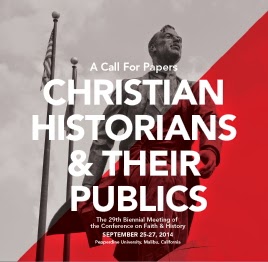
Last weekend I traveled to sunny Malibu for the 2014 Conference on Faith and History. As you can see from the image on the left, the conference theme was centered around the notion of the historian's "public." As a graduate student, my perspective on who my public is and how I want to reach them is necessarily different from established historians. Thanks to my participation in a roundtable focusing on "Christian Historians and Social Media," I was able to discuss some of those differences.

The mastermind behind the roundtable, Jonathan Den Hartog, orchestrated a plan to have each of the participants post his comments from our roundtable online this week. You can read Den Hartog's introductory remarks at his blog, John Fea's comments at his blog, and Chris Gehrz's reflections at (yes) his blog. Or one of his four blogs, I should say.

To round out our series of posts, here are my comments. They have not been edited for clarity or length. You get 'em in all their original muddled glory.
                                                                                                                                                          

Friday, August 15, 2014

Favorite Writing Music in 2014

We're now into the second half of 2014, and as usual I've been keeping track of my favorite new albums. I'm never able to keep up with everything that comes out, but from what I have listened to thus far my top 12 albums list would probably include (in some order): The War on Drugs, Conor Oberst, Lykke Li, Old 97s, Cloud Nothings, Sun Kil Moon, Run River North, How to Dress Well, The Roots, Common, Spoon, and Atmosphere. 

Usually I approach a new album by listening to it all the way through a few times, then selecting the songs that I like from the album and adding them to a "Best Songs of [Year X]" playlist on Spotify. Those songs then get played extensively whenever I take up a writing project. Below, I've compiled my ten favorite writing songs from albums released in 2014. This isn't necessarily a "ten best songs" list. Rather, it's a list of the songs that have provided the best writing soundtrack. As you can see from the list, I tend to gravitate towards songs that are wistful, pensive, or earnest in tone. Suggestions/snide comments welcome.

(Since some albums had multiple songs that would have made the list, I decided to limit each album to only one song. Click on song title to check out the songs for yourself.)


Tuesday, August 5, 2014

Finally, a Langball Explainer

What is langball? (also known as "Lang ball" and "hang base ball")
Langball is a now-defunct game invented by C.G. Lang, a YMCA director in St. Joseph, Missouri, sometime around 1892. It's something like baseball or kickball, except that the batter in langball dangles from a horizontal bar or flying rings, striking the pitched ball with the bottom of their feet. Kind of like this:

Pic from Los Angeles Herald, April 19, 1896.

What happens after the ball is kicked?
The batter then runs to first base, much like in baseball, with the goal of eventually making it back to home base and scoring a run. Depending on the rules being used, there could be as few as two bases or as many as four.

Any fly ball caught by the defense is an out. But the rules for getting a runner out vary: if a light rubber ball is used, then the defense must hit the runner with the ball to get them out. Sometimes, however, a medicine ball is used. This brings an element of danger, for (as one early promoter of the game explained), "this indiscriminate throwing will endanger windows and apparatus, if not heads." Thus, the medicine ball version usually outlawed throwing at runners to get them out. Instead, you threw to the base, as in baseball.

Pic from Physical Education 1.2 (April 1892): 32.

Thursday, July 24, 2014

For Christians, Must Art Always Serve A Purpose?

Over at Christ and Pop Culture, Jordan Monson wrote a short piece titled "Do Christians Have Poor Cultural Taste?"

Monson began the piece by describing a "beautiful and melancholy" film that he viewed with a couple Christian friends. Monson loved the film: "In a mere three hours it led me through the full spectrum of human emotion," he wrote. "I empathized—even lamented—for its fictional characters. But my sorrow was of the redemptive kind, and it convicted me to go forward and share the hope of Christ with those who search in vain."

But his friends were not so enthused. One didn't like its lack of transforming robots; another thought that it did not teach viewers the proper moral behaviors.

From there, Monson began to wonder why it was that his friends and many other (evangelical) Christians were unable to appreciate the movie like he was. He assigned three factors to this tendency: having poor taste, "misunderstanding the role secular art can play in our lives," and something about fast-food culture vs. art.

Monson brought in the big gun for his analysis: C.S. Lewis. Lewis, according to Monson, argued that to have good taste one must receive art ("temporarily suspend judgment")  instead of use art (where art is simply a means to advance one's agenda). Monson agreed, arguing that evangelicals must learn to receive art (in a discerning way, of course), even from "secular" sources. And he suggested that approaching art in this manner "should inspire us to grow into better Christians, parents, evangelists, laborers, and listeners."

Like Monson, I too have wondered why it is that evangelical Christians have a tendency to enjoy terrible movies, music, and books. But it's not just the enjoying part -- the movies, music, and books that are most popular among the broad American population I often find terrible, too. What makes many evangelicals different is the fact that they often really, really want others to enjoy the cultural good as well (this is why they do things like rent out theaters for Son of God). Many believe that by getting others to partake of the cultural good, others will be sanctified or made better in some way. And on the other side of the coin, many evangelicals believe that some movies/music/books (often deemed "secular") will make people spiritually worse in some way. Why is this?

Thursday, June 26, 2014

College Majors and College Degrees for the 2014 NBA Draft Prospects

To complete my various posts related to the NBA and college degrees this week (see herehere, and here), it's time to take a look at the 2014 crop of NBA prospects

It should come as no surprise that most of the top talents in the draft don't have a college degree. The reason is simple: it makes little sense to stay in school for four years while the NCAA, your conference, and your school all make money from your basketball ability. If you are talented enough to be a first round pick in the NBA and get a guaranteed three-year contract worth millions, you should probably get out of the NCAA ASAP. If a college degree is important, there is always time to go back after (and even during) your NBA career.

Fitting in with recent precedent, this year only four of Draft Express's top 35 prospects can claim to have a college degree. But if the likely first-round picks are set aside, the number of college degrees ticks up quite a bit. Over half (thirty-eight in all) of Draft Express's prospects ranked from 36-100 have college degrees. And many of those prospects who do not have a degree are international players who did not attend an American college. In short, college players who are not locks to be a first-round pick often stick around for four years, get their degree, and then hope for a shot with an NBA when it's all done.

Of course, the transition from college to the NBA was not always set up this way. Originally, the NBA's rule was that rookies could not play in the NBA until their college class graduated. For example, when Wilt Chamberlain decided in 1958 to forego his senior year at Kansas, he had to wait a year -- even though he was drafted by Philadelphia through the NBA's territorial rule -- before he could enter the league.

Since players had to wait four years after high school graduation anyway, most stayed in college and got their degree before they entered the league. Those who did not generally had only a couple courses left to complete for the degree. This was the situation for Chamberlain's rival big man, Bill Russell. Russell planned to finish his classes at San Francisco during the summer after his first NBA season. However, when San Francisco made it clear that Russell would have to pay for the courses himself, he left the school, never to return (and never to receive his degree).

So what caused the NBA to change its policy?

Wednesday, June 25, 2014

The Most Interesting College Degrees in the NBA

Over the past two days I've used a not-biased-at-all research process to determine which college degree has produced the best NBA players. (Here are the links to Part 1 and Part 2). But since I only included the college degrees that had at least six NBA players, there were some interesting degrees left out of my analysis. Below, I've included a few of them.

1) Emeka Okafor (Finance), Jeff Hornacek (Accounting), and David Robinson (Mathematics)

The number crunchers. Before you get to the jokes about how boring accountants are, here's a video of Jeff Hornacek subverting accounting stereotypes.


2) Kyle Korver (Visual Studies), Kyle Singler (Visual Arts), Patrick Ewing (Fine Arts, poster/print design)

In contrast to our first group, these three are on the opposite side of the right brain/left brain false dichotomy. Kyle Singler's art projects used to get attention back when he was winning national titles with Duke. But no one has put their studies to better use than Patrick Ewing.


Tuesday, June 24, 2014

The Fifteen Best NBA Teams Of All Time...If Those Teams Were Organized By Players' College Degrees (PART TWO)

Continuing on from part one, here are the seven best college degrees for producing star NBA players.  

7. ECONOMICS
G - Dave Bing
G - Lenny Wilkins
F - Adrian Dantley
F - Jamaal Wilkes (now Jamaal Abdul-Lateef Wilkes)
C - Bill Laimbeer
6th Man - Kiki Vandewedghe
Missed the cut: Joe Barry Carroll, Festuz Ezeli, Jeremy Lin

From here on out, it’s incredibly difficult to find glaring weaknesses. Each team is solid 1 through 6, has a good inside/outside balance, and has no out-of-position players.

I really like the balance that this roster would provide. They’ve got four Hall-of-Famers (Bing, Wilkins, Dantley, Wilkes), and two guys who are on the near-miss HOF list. The problem with this team, compared to some of the teams in the top six, is that even though all of these players were great, none of them were truly elite. They’re like the 2001–2008 Pistons. And even though Wilkes (2 All-Defensive teams) and Laimbeer were both recognized for their play on the defensive end, neither player was especially adept at blocking shots.

Also, there is some degree drama with this team. Dave Bing, who eventually became mayor of Detroit (maybe not something you want on your resume), lied about having an MBA and also claimed that he received his economics degree thirty years before he actually completed it. But I won’t hold that against him: whenever it happened, he’s still got an economics degree.

6. GENERAL STUDIES
G - Norm Nixon
G - Jason Terry
F - Alex English
F - Buck Williams
C - Shaquille O'Neal
6th Man - Xavier McDaniel
Missed the cut: Ervin Johnson, Steve Kerr, Keith Jennings

As with the Psychology team, my bias in favor of elite big men is coming out with this ranking. Besides O’Neal (who will be in the HOF), only English currently has a place in the Hall. So how can I put General Studies ahead of teams with multiple Hall-of-Famers?

First, all six players had long, consistently good careers, and all but Terry made at least one all-star game.

Second, the pieces fit incredibly well. You’ve got guards in Nixon and Terry who are dangerous offensively but don’t constantly need the ball, which frees up O’Neal to dominate. English would be a great wing scorer to play the Hardaway/Bryant/Wade role for Shaq, and Buck Williams was a four-time All-Defensive team player who could focus on defense and rebounding. McDaniel would provide great scoring punch off the bench.

Third, Shaq. Don’t forget how dominating he was.

One potential problem: Norm Nixon famously got into a tiff with Magic back in the early 1980s. Given Shaq’s history of intra-team rivalries, that might not bode well for team chemistry. On the other hand, Shaq and Kobe did win three rings together.

5. SOCIOLOGY*
G - Steve Nash
G - Lionel Hollins
F - Dale Ellis
F - Nate Thurmond
C - Alonzo Mourning
6th Man - Mitch Richmond
Missed the cut: Larry Johnson, Rolando Blackman, David Lee, Shareef Abdur-Rahim, Andre Miller, Jameer Nelson, Brent Barry, Christian Laettner, Dell Curry, Keith Van Horn, Johnny Newman

A deep pool of players to choose from certainly helps, and sociology was a popular degree choice, especially among more recent players (it was the third most popular degree overall).

I’m beginning to sound like a broken record here, but I love how this team fits together. Any defensive weaknesses brought by Nash and Ellis would be completely obliterated by the terrifying tandem of Thurmond and Mourning. Those two aren’t plodding big men who wait around the rim and occasionally happen to blog shots because they’re big (a la Shaq). They’re athletic and rangy. They’ll hunt you down.

On the offensive side you’d have Nash running the break with bigs who can actually run, and in the half court set driving and kicking to dead-eye shooters like Richmond and Ellis. Hollins, meanwhile, was no slouch. He was a perfect role player, handling the ball when needed and locking down the other team’s best guard (twice he was named to an All-Defensive team). In short, he’d be the perfect compliment for guards and wings like Nash, Ellis, and Richmond.

As for other accolades: all six players were All-Stars, and if you count the not-yet-inducted Nash, four of the six are Hall of Famers.

4. COMMUNICATION


G - Gus Williams
G - Gary Payton
F - Magic Johnson
F - Maurice Lucas
C - Elvin Hayes
6th Man - David West
Missed the cut: Derek Fisher, Vin Baker, Juwan Howard, Danny Ainge, Mark Jackson, Danny Manning, Michael Adams, B.J. Armstrong, A.C. Green, Ralph Sampson, Theo Ratlif, Al Horford, Charles Smith, Bruce Bowen, Byron Scott, Mark Alarie, Jim McKilvane, Jayson Williams, Landry Fields, Thurl Bailey, J.R. Reid, Muggsy Bogues, Tyrone Hill, Brian Grant, Damon Stoudamire

More players have a communications degree than any other degree, so it’s a little bit difficult to wade through roughly equivalent players and nail down a six-person team. I feel absolutely confident about the starting five. But West as the Sixth Man? I’m just throwing darts. You could easily make a case for Horford or Hawkins as the better pick.

Some might argue that Mark Jackson deserves the PG spot. But I’d rather have a more multidimensional player to go alongside Payton. Williams may not be a household name, but he was one of the NBA’s best guards in the late 1970s and early 1980s. Plus, his inclusion brings back happy memories for Seattle’s NBA fans, and Lord knows they need it.

The great thing about this team is that it combines Magic Johnson’s brilliance-with-a-smile with the one-two swagger/intimidation punch of Payton and Lucas. Johnson is in the GOAT class of NBA standouts, which immediately makes this team difficult to deal with. Not far below him is Gary Payton, who won a defensive POY and was named to nine All-NBA and All-Defensive teams. There’s also Elvin Hayes, an all-star in three different decades. On top of that, six players went to at least one All-Star game. There’s just not much of a weak link, other than three-point shooting.

This team would have the guards to handle Nash & Co from Sociology, and the bigs to battle Zo. But I can’t put them ahead of the Bird-led Physical Education squad, and not just because of my pro-Celtics bias.

3. PHYSICAL EDUCATION
G - Jo Jo White
G - Jerry West
F - Paul Pressey
F - Larry Bird
C - Wes Unseld
6th Man - Ron Harper
Missed the cut: Vinnie Johnson, Don Nelson, David Wesley, Mike Woodson, Alvin Attles**

First, can we stop the charades and put Jo Jo White in the Hall of Fame already? Back in 2007, ESPN discussed five players who have been snubbed by the Hall. Four of those five have subsequently gotten in, but not White. The guy was a seven-time All-Star, made two All-NBA second teams, and won a finals MVP. If we're letting Joe Dumars and Reggie Miller in, it's time to let White in as well.

Another underrated player on this team: Paul Pressey, who some claim was the "original point forward." Rick Barry and Marques Johnson might have something to say about that claim, but at the very least Pressey was unique. A 6'5 forward who could pass like a point guard, he was also an efficient scorer (shooting 48.5% for his career), and an excellent defensive player (claiming three spots on NBA All-Defensive teams).

Joining White and Pressey would be lunchpail-carrying Hall-of-Fame pivot Wes Unseld and two of the top fifteen players in NBA history. There's a reason I don't have to write much about Bird and West. You already know.

Harper is a good-but-not-great sixth man, but people who remember him only from his days with the Bulls underestimate what a solid career he had. The main weakness with the team isn't Harper, but the lack of height and/or rim protectors. Unseld was great, but he was only 6'7 and never averaged over one blocked shot per game.

As a final note, even though he didn't make the top six it's worth mentioning that physical education grad Don Nelson (yes, that Don Nelson), didn't receive his degree until 2012, fifty years after he first enrolled at Iowa.

2. BUSINESS
G - John Stockton
G - Bob Cousy
F - Oscar Robertson
F - Bob Pettit
C - Bob Lanier
6th Man - Joe Dumars
Missed the cut: Jerry Lucas, Michael Finley, Phil Ford, Reggie Theus, Calvin Natt, Matt Bonner, Kevin Grevey, Dan Rounfield, Etan Thomas, Rick Mahorn, Clarence Weatherspoon, Kerry Kittles, Matt Harpring, Jeff Mullins, Larry Smith, John Salley*

Before we get into how great this team is, and how all six players are Hall of Famers (and a seventh, Jerry Lucas, didn't even make the cut), let's face facts:

Bob Cousy and Bob Pettit, as great as they were, still did most of their damage in an era in which black players were only allowed to enter the league in limited numbers. In 1962, for example, less than a third of the NBA's players were black and no team had more than four. The same caveat applies to Robertson, but to a much lesser extent because he didn't start his career until 1961 (Cousy and Pettit played the bulk of their careers in the 1950s).

Also, Cousy (37.5%) and Pettit (43.6%) would have been miserable shooters by today's standards. Granted, it was a different era, the game was played differently, and so on and so on. But when you're comparing players across eras, you have to at least take those sorts of things into consideration.

With that out of the way, let's recognize the greatness here. Pettit, Robertson, Cousy, and Stockton were all 11-time All-NBA performers. Robertson's career averages are insane. Not only did he shoot 48.5% for his career (in an era when the FG% was generally much lower), but he also put up 25.7 points, 7.5 rebounds, and 9.5 assists per game. Stockton's numbers are amazing as well: he shot at a 51.5% clip while averaging 10.5 assists and 2.2 steals per game. Even the weak spots on this team had stellar careers. Lanier never made an All-NBA team, but he averaged a 20/10 for his career. Dumars was an outstanding three point shooter who doubled as a lock-down defender (he was named to 5 All-Defensive teams). Simply put, it's tough to find a weakness.

So what sort of juggernaut could possibly defeat this team?

1. HISTORY
G - Grant Hill
G - Reggie Miller
F - Billy Cunningham
F - Bill Walton
C - Kareem Abdul-Jabbar
6th Man - Bill Bradley
Missed the cut: Raef LaFrentz, Andrew Declercq, Adonal Foyle, Alvin Attles**

Was this entire countdown just history boosterism dressed in the guise of NBA fandom?

Perhaps.

But let me submit my case for why History is number one.

First: Kareem is the second-best NBA player to receive a college degree. And the best (Michael Jordan) is not represented on any of these teams (more on that here). I'm a firm believer that if you have an unstoppable big man, then all other things being somewhat equal, the unstoppable big man wins. Kareem, a six-time MVP, is clearly superior to Lanier. The only question is if the rest of his team can compete with the Business squad. Which leads me to...

Second: all six players are Hall of Famers. Billy Cunningham, nicknamed the "Kangaroo Kid" for his leaping ability, was named to four All-NBA teams, then switched to the ABA and won an MVP. At 6'6 and rangy, he could match up with Oscar Robertson. Grant Hill, named to five All-NBA teams, would take on the primary ball-handling role, something he did for the first seven years of his career anyway. Reggie Miller's penchant for clutch shots and his reputation as one of the best three-point shooters in NBA history is well known. Bill Walton's NBA career was cut short by injury, but he is still known as one of the best passing big men of all time.

Imagine an offense centered on a high-low game with Walton at the elbow and Kareem working the low post. Cunningham would be screening, cutting, and hitting the boards, Miller would be the floor spacer, and Hill would take on the PG duties. Off the bench you'd have Bradley, the well-rounded SF who was good at most aspects of the game.

While Business would still have the advantage at the guard and wing spots, surely History would make up for it with its dominating play in the paint, its superior critical thinking skills, and/or its leftist critique of the bourgeoisie capitalism embraced by Business. Right?

Right.

*Three guys in the "Missed the cut" list for the Sociology team actually had Social Science degrees.
**Alvin Attles had degrees in both history and physical education.

Coming tomorrow, part three: a look at the unique college degrees that NBA players have received, and a statistical overview of the distribution of degrees.

Links to three other basketball-related posts I've done:
1) A look back at the Kansas City-Omaha Kings
2) Reflecting on the 1990 NBA Draft
3) Jesse 'Cab' Renick, the American Indian U.S. Olympic Basketball Captain

Monday, June 23, 2014

The Fifteen Best NBA Teams Of All Time...If Those Teams Were Organized By Players' College Degrees

This was originally posted in 2014. It has since been updated to reflect Shaka Smart's new home and Kevin Johnson's newly unveiled depravity.

Last week while reading an article about VCU  Texas coach Shaka Smart, I was reminded once again that Smart has a history degree. Every time I find out that famous people studied history in college, I get excited.

As an NBA diehard, I also began to wonder what college degrees have been most popular among the NBA's best players. A few hours later, this post was the result: a list of the top 15 NBA teams of all time, if those teams were composed only of players who earned the same college degree.

But before I get to the list, a couple quick notes.

1) I'll let others cite Elden Campbell and the recent North Carolina academic scandal to pontificate on the legitimacy of NBA players' degrees. The fact is, most professional athletes do not receive degrees, and for good reason: they want to get out of the exploitative NCAA system as quickly as possible. I want to recognize and celebrate those players who managed to get a degree while also making some money for themselves with their basketball ability.

2) At the same time, I'm not trying to suggest that all NBA players need to get a college degree, or that a college degree is the best measurement of one's intellectual ability. It won't, for example, guarantee that you can tell the difference between a "2009" and "2012" New York Times story when pontificating about Lebron’s lack of a college degree. It also won't give you the good sense not to use the word "pontificate" in back-to-back paragraphs.

3) Finally, some quick notes on my rules for picking the teams:
  • To be represented here, at least 6 NBA players (from any era) had to have the degree.
  • Using my whims, biases, and limited knowledge, I ranked the teams ONLY on the quality of their top six players. I'm measuring quality, not quantity. 
  • If at all possible, teams were formed to make sure that two guards, two forward, and a center were represented, with a guard or forward as the sixth man. 
  • I attempted to put teams together based on "best fit" (i.e. how I think they would play together) rather than simply going off of stats or who was the best one-on-one player. 
  • Since degree programs are not uniform across all universities, I sometimes grouped similar degrees together. For example, I put social work with community studies, because there is often overlap between the two.
  • The teams are ranked in reverse order, from worst to first. 
  • If you'd like to know more about how I compiled this list and what sourced I used, shoot me a message.